OKEANOS researchers explore Equatorial Atlantic and share discoveries with Horta students
OKEANOS researchers explore the deep Equatorial Atlantic on The Gap expedition and share their discoveries live with around 50 school students in Horta.
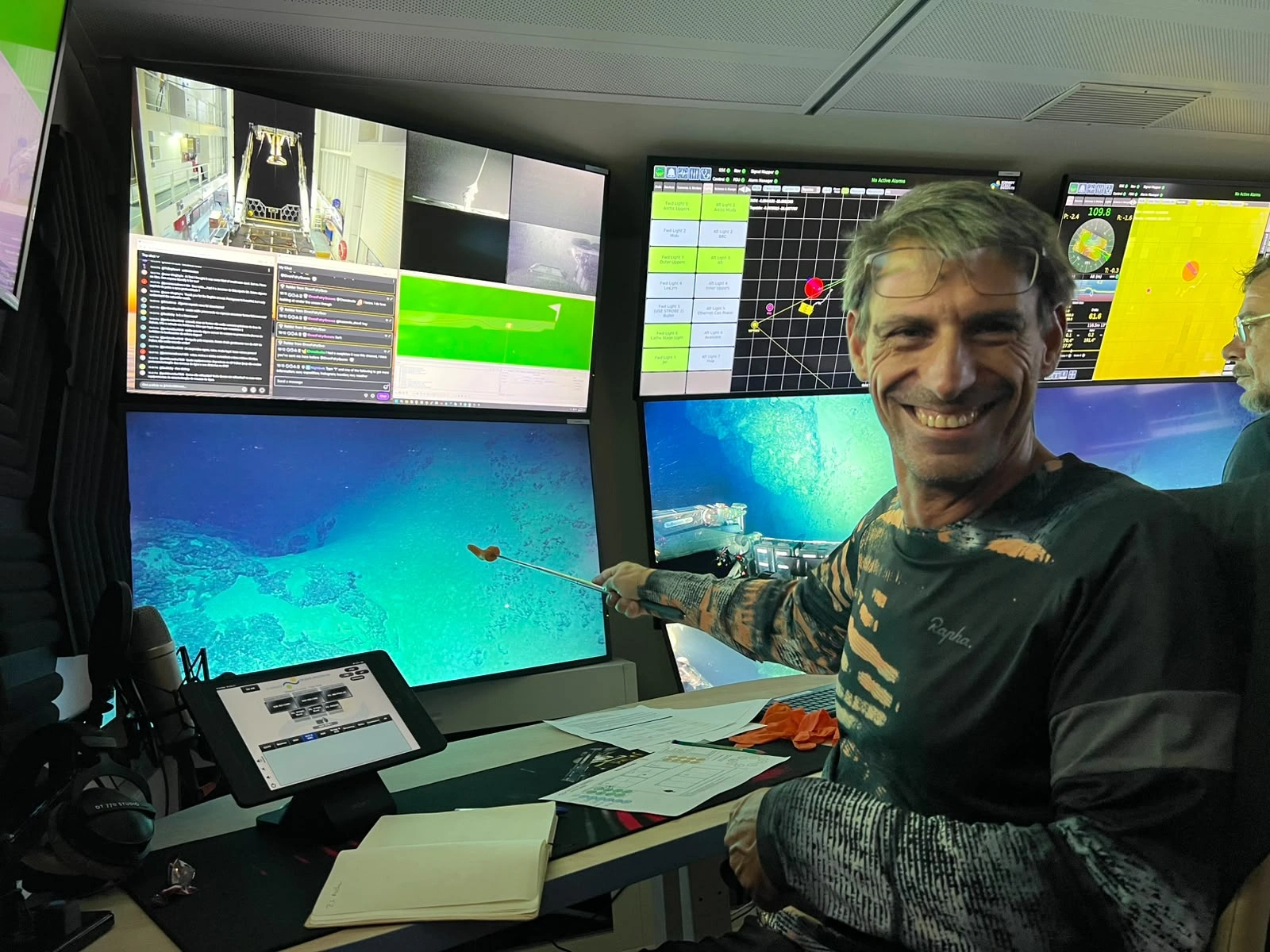
Three researchers from OKEANOS, the University of the Azores' Institute of Marine Sciences, are taking part in The Gap, an international scientific expedition exploring the deep Equatorial Atlantic. Telmo Morato, Inês Bruno and João Balsa are working aboard the Schmidt Ocean Institute's research vessel Falkor (too), which also hosted a live connection with around 50 students at Escola Secundária Manuel de Arriaga in Horta.
Led by Brazilian researchers and involving scientists from Portugal, the United Kingdom and Italy, the expedition is studying the Romanche Fracture Zone, one of the least explored regions of the Mid-Atlantic Ridge. The team uses the remotely operated vehicle SuBastian to observe marine life and collect samples at depths of up to 4,500 metres.
According to the OKEANOS press release, researchers observed cold-water coral gardens along the upper edges of the fracture walls, between 1,000 and 1,500 metres deep. Another notable finding was a sponge garden at approximately 4,200 metres, where the team had not expected to encounter this type of ecosystem.
The expedition also recorded organisms that may represent species new to science. Confirmation will require laboratory analysis of the collected samples.
The Romanche Fracture Zone is a submarine valley approximately 1,000 kilometres long and an important deep-water passage between the western and eastern Atlantic basins. Located almost entirely in international waters, it can provide valuable information for future conservation measures under the High Seas Treaty. Telmo Morato emphasises that identifying vulnerable ecosystems, including coral gardens and sponge aggregations, is essential to support protection decisions.
The expedition's educational programme reached Horta on 26 October through the Ship to Shore initiative. Around 50 students at Escola Secundária Manuel de Arriaga spoke live with OKEANOS researchers aboard Falkor (too), learned about the expedition's objectives and discovered some of the organisms found in the deep ocean.
The session included an introduction to SuBastian and a virtual tour of the control room, where underwater operations are monitored and coordinated. Students also learned about the challenges and technologies involved in exploring remote ocean environments.
Marisa Gomes, project and communications manager for the Azores Deep-Sea Research team, highlights the role of these initiatives in connecting scientific research with society, encouraging young people's curiosity and making knowledge about the ocean more accessible.
More news
November 9
Inter-island flights account for largest share of October arrivals in the Azores
Azores airports recorded 166,649 passenger arrivals in October, down 8.2% on 2025, with inter-island flights accounting for the largest share.
November 9
Azores social sector prepares fresh action over pay and career progression
Social sector workers in the Azores plan a 7 December strike, seeking 2026 pay rises, backdated payments and improvements to career progression.
November 9
Men in the Azores have a life expectancy 6.21 years lower than women
Life expectancy at birth in the Azores is 78.69 years, and the gap between women and men is the largest in Portugal, according to figures for 2023–2025.